
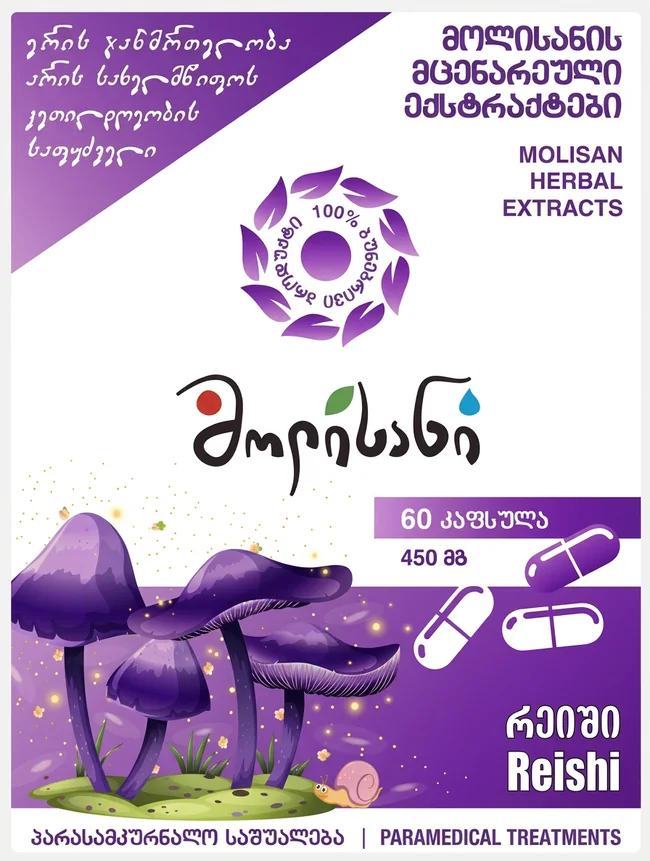
 Enlarge photo +
Reishi
Traditional immune system support.
Full descriptionChoose a pack
Next, review your cart and enter your details. You will go to WhatsApp only after completing the form. Delivery is not included in the total.
Please confirm availability and delivery terms before ordering.
Product information
Description
Ganoderma — Reishi (Ganoderma lucidum) — is a species of wood-growing fungus. Its history dates back to the second millennium BC. Finding this mushroom in the wild is a great stroke of luck. Ganoderma is known as the “mushroom of immortality” or “divine herb”. In China, it was considered the most important medicinal plant. According to ancient sources, this mushroom was regarded as a remedy that restores youth and prolongs life. Only emperors and members of high society used it.
Composition
Organic reishi (Ganoderma lucidum) extract, gelatin (capsule).
Uses
Directions for use and contraindications
Directions for use: Adults: 1 capsule 2 times a day with meals.
Contraindications: Not recommended during pregnancy or lactation. Do not take together with medicines (chemical or hormonal).
Storage conditions: Keep closed at room temperature and protect from sunlight
Additional information
In traditional Chinese medicine, this mushroom is considered the best remedy for curing many diseases. It contains steroid compounds — flavonoids, saponins, amino acids, alkaloids, polysaccharides, water-soluble proteins and coumarin. Trace elements: Ag, Ca, Fe, K, Na, Mn, Zn, Ba. Bioenergetic action: ancient Chinese books state that it directly affects the meridians of the heart, liver, lungs, spleen and kidneys. Ganoderma is believed to increase spiritual strength and enhance a positive emotional state.
Reishi — the “mushroom of immortality”
Contains polysaccharides and ergosterols that enhance immune system function. Reishi has been found to lower blood cholesterol, regulate blood viscosity, reduce platelet density and normalise blood pressure. Reishi is an excellent adaptogen: it improves the normal functioning of all body systems.
Pharmacological properties
Reishi is a powerful adaptogen and immunomodulator: it protects cellular DNA, cell mitochondria and renal tubular cells from oxidative damage, which is a precondition for ageing and tumour development; participates in stem cell growth and maturation; clears radioactive caesium (Cs) and strontium (Sr) from the bone marrow; removes heavy metal salts from the body; increases the body’s resistance to adverse environmental conditions; enhances the normal functioning of the whole body and its organs; increases the body’s vitality; increases its cytotoxic activity against atypical cells; and is a powerful antioxidant.
Reishi — a powerful hepatoprotective agent
It has the ability to reverse fibrotic liver cells; by activating the production of cadmium-binding proteins, it reduces cadmium (Cd) accumulation in the liver; it reduces inflammation in liver cells and restores the liver’s normal detoxification function. Reishi is a powerful neuroprotectant: it stimulates nerve growth factor, enhancing neuronal mitochondrial function; it reduces the destructive effect of beta-amyloids (Abeta) on neurons, which is a triggering mechanism in Alzheimer’s disease; and it protects brain cells from the inflammatory process that plays a leading role in Parkinson’s disease.
Reviews
Read about MOLISAN customers’ experiences in the main archive.
Review archive